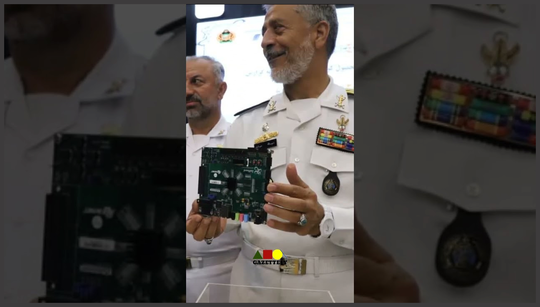

The Iranian navy's claim of a 'quantum processor' has now been officially debunked, with a university blaming the media for misrepresenting what it claims is a 'FPGA board.' The navy presented the device at a maritime conference, asserting its capability of quantum entanglement. However, it was later revealed to be a $600 dev board available on Amazon, raising questions about the university's recognition of a genuine quantum processor.
Elaborate Prank on the Country
The incident, which can be seen as an elaborate prank, follows initial claims by Iran's Imam Khomeini University of Marine Sciences and Technologies, which declared the development of the 'first product of the quantum processing algorithm.'
However, experts quickly identified the board as a ZedBoard Zynq-7000 development SoC, a programmable hardware development platform for software developers and hardware designers. The device, available on Amazon for around $600, lacks the necessary specifications to function as a quantum processor.
'Quantum computations require a lot of memory, and this device only has 256GB of storage. It's also lacking a pretty hefty processor,' explained Dr. David Sivyer, a senior fellow at the Royal United Services Institute.
Despite the error, Iran emphasizes that the proposed algorithm's ability to address disturbance in surface vessels' positioning systems is still significant for maritime security.
'Due to disturbance in the communication channels, it is difficult to maintain the vessels' positioning systems on a constant and accurate track,' described Iran's navy in its initial announcement. 'The proposed algorithm, however, is capable of providing the vessels with uninterrupted positioning services under the mentioned conditions.'
Following media attention, Iran reversed its initial announcement, with the country's Research vice chancellor admitting that the device was 'mistakenly portrayed as a quantum processor' by the media.
'The device unveiled at the event was a programmable hardware development platform,' stated the vice chancellor, 'and the presented algorithm is designed to operate on such platforms.'
Despite the error, the navy still views the unveiling as a positive development. 'The navy is happy that scientists have taken notice of its challenges and are trying to help resolve them,' said Rear Admiral Habibollah Sayyari, Coordinating Deputy of the Islamic Republic's Army.
While the device itself is clearly not a quantum processor, it highlights the need for technical knowledge and proper scrutiny in scientific announcements. The incident serves as a reminder to the media to consider the worthiness of reporting on scientific claims without adequate background knowledge.