
Gigabyte Aero 14 OLED
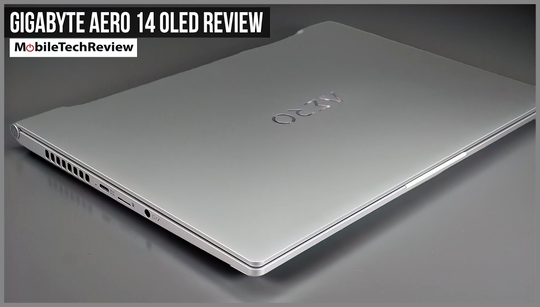
Wondering what exactly we think of the Gigabyte Aero 14 OLED? We’ve taken an in-depth look at this powerful laptop to find out what makes it tick. Anyone who has used or seen an OLED screen will know exactly why it earns this review’s first kale tick, but does the rest of the laptop match up?
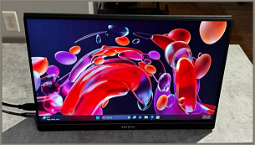
The Aero 14 is, undeniably, a stylish laptop. The IHS upgrades the display right off the bat, with a resolution of 2880 x 1800 and a 90 Hz refresh rate imparting motion with a heightened degree of smoothness. Combining this with the exceptional brightness, color range, and contrast of the OLED screen, and you’ve got a recipe for some lovely visuals.
That’s not to say there aren’t a few dents in the Gigabyte Aero 14’s armor. The keyboard layout is mostly good, but the arrow keys really should be their own cluster, and the key travel is on the rubbery side. The touchpad is rightly sized, pairing a glass surface with tactile clicks, but it makes a highly audible click when pressed and wobbles a little when typing.
As already mentioned, the Aero 14’s speakers are rather unimpressive, sound-wise. They’re suitably loud and capture a good degree of low-frequency, but they sound muffled and struggle with audio quality – even at moderate volumes. Thankfully, Gigabyte includes a desktop app to help with this, transforming the laptop’s audio with the press of a button.
As far as battery life goes, the laptop’s specs are really quite unimpressive. We managed to get just five hours and 37 minutes out of the Aero 14 during our battery test, a time which falls pretty far behind the Lenovo Slim Pro 7 and Apple MacBook Pro 14.
The Aero 14’s individual components are a bit of a mixed bag too. The other main components, such as the wireless card, SSD, and keyboard, for example, all seem serviceable, with nothing standing out as particularly negative. Even the heat management is mostly good, with an average score of 13,397 points in the Cinebench R23 CPU benchmark putting the Gigabyte laptop on par with the Lenovo G505. Sure, it’s behind the Asus FX504, but it’s a lot slicker than the Razer Blade Stealth.
Our review unit takes a slight performance hit owing to driver updates, but it still performs well in productivity tests. At the same time, it lags behind in the decidedly unproductive Handbrake transcoding test. Admittedly, it’s on par with the MSI Nightblade MIF and Razer Blade Stealth, but we’d personally prefer all laptops to handle whatever you throw at them equally well.
On the subject of components, it feels time to address the elephant in the room: the Gigabyte Aero 14 OLED’s RTX 4050 graphics card. Nvidia’s latest generation of desktop GPUs have been met with mixed reviews across the board, and for good reason. The chipset itself is actually pretty capable, it’s just not being deployed in devices that can harness its power without breaking the bank – well, not without the help of a warranty code, anyway.